Friday, 20 June 2014

A Square of Cubes in Year 4


For instance, with n=3, the first three cubes
 - here made in Cuisenaire rods - can be reassembled into a square:
The square is six units wide, six being the third triangle number.

The puzzle then, was to make the cubes and then make a square from them. The class managed that successfully and it might have finished there, but when the following day they were asked to create a growing pattern of their own in Cuisenaire rods
and bigger - swallowing up all the Cuisenaire rods in the school, until they had created a monster:
The next day, while the rest of the class explained their own patterns, the four girls enthused about their creation.

It was time to have a closer look at the patterns of numbers hidden inside this huge square:
square numbers
triangle numbers
And then, to round it all off, a display outside the class:
with the invitation to make the cubes and the squares from the same rods:
We rounded it all off by inviting the Year 2s and Year 3s to find out what it was all about.  The four girls explained their creation brilliantly!

Wednesday, 28 May 2014

Weaving the Three Times Table

This is something from the archives, from Year 1.

In our topic on clothes, we'd looked at denim under the microscope. It looked something like this:


This is the 'back' of it
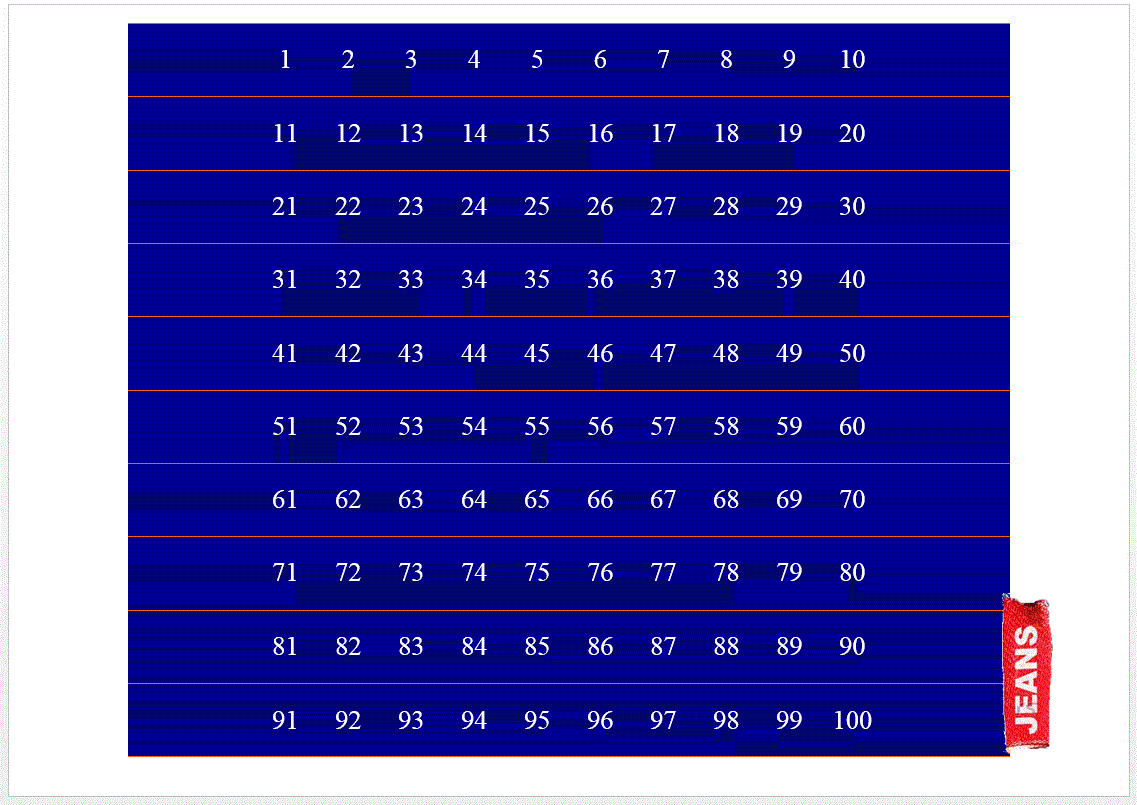
We saw the way the blue threads went over two and under one. We made the pattern on a hundred square by filling the right cells white on a Word document:
Click on image to download Word doc
It looked like this when we'd finished (after correcting some mistakes):


 Then we used another Word document, printed onto A3 cartridge paper and cut with a Stanley knife along the vertical lines:

Click on image to download Word doc
On this sheet we circled the multiples of three. Now it was just a question of threading blue strips in to make the same pattern, over two numbers not circled and under the circled multiples of three. The class really concentrated and got some great results!


Wednesday, 21 May 2014

Number Balances in Year 4

We've been working with our new number balances in Year 4.


The two sides of the balance have to balance.

We created lots of balanced numbers. Like this:


You'll notice there's more than one weight on some numbers!

We also did the same thing with an online version from nrich:


We made lots of them!


And a whole lot more!

 The challenge, though, is to work out where the weights were the next day!


We're writing them as equations:


We also had a go at this balancing game (which starts out easy then gets a little harder):


This one, Weigh It Up, starts out easy and gets harder too:


Saturday, 26 April 2014

Pie charts and percentages with Smarties

This was a nice easy and fun way to explore percentages and pie charts - plus it was edible! It came from an image on Twitter:

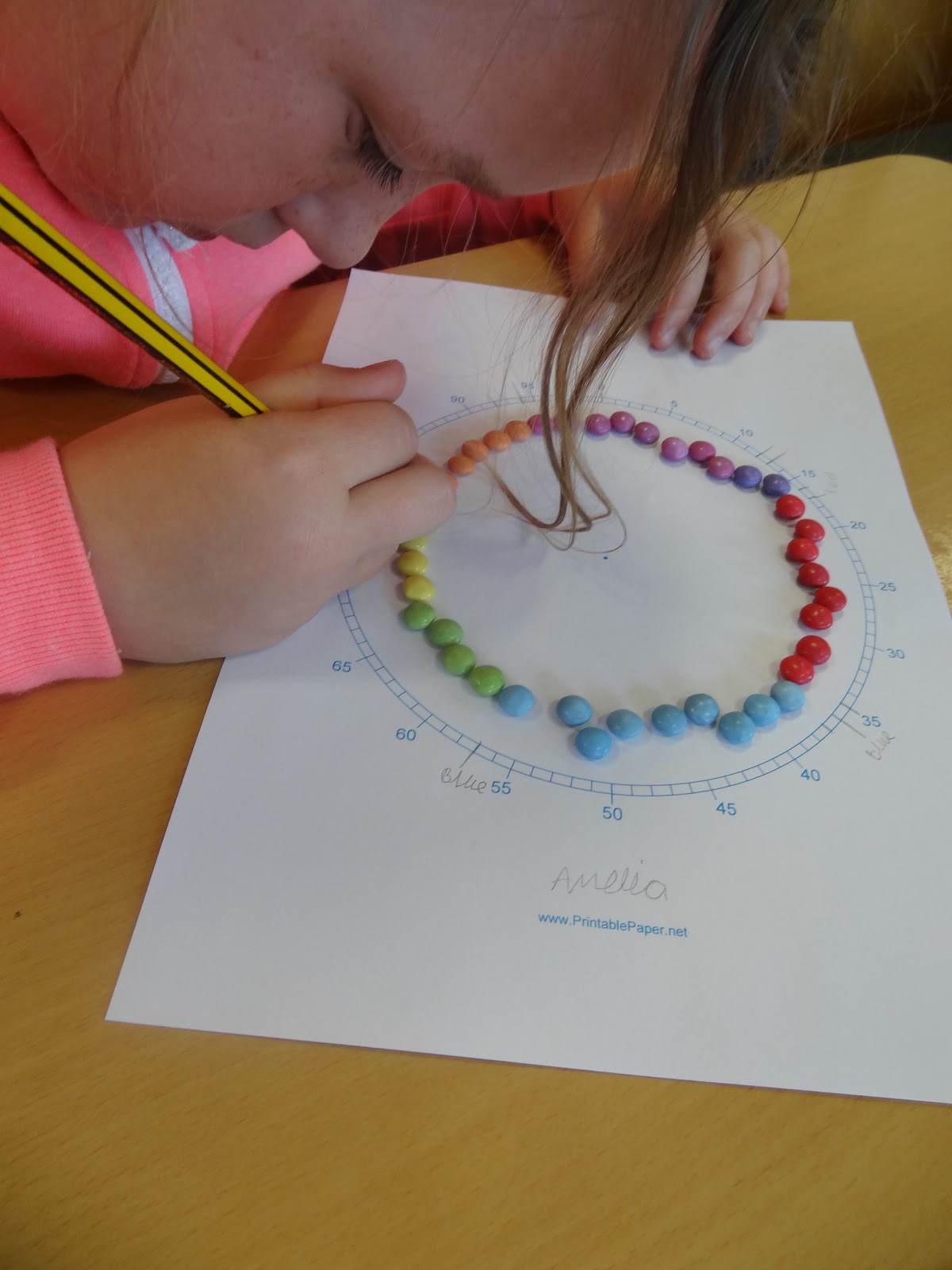
What a great way of doing pie charts! No arithmetic involved! Normally there is just a little too much involved in achieving a pie chart. How about we combine that with a circle divided into one hundred - then we simply have to count around that circle for the percentage! The paper was there on printablepaper.net.

So we handed out the boxes of Smarties. 


We each had a packet, and sorted them into colours. Then we arranged them in a circle. That was the tricky bit. Sometimes we had to jiggle the circle quite a bit so all the Smarties would fit, and so it was fairly circular. We marked off the different colours on the outside circle divided into a hundred.


Then we coloured in the circle with the right colour, and added on some pie cuts:


Here are more photos:


And the finished pie charts look like this:


Wednesday, 23 April 2014

Five Rectangles

In Year 4 we've been looking at a puzzle, taken from Gary Antonick's 'Numberplay' in the New York Times:
Create a set of five rectangles that have sides of length 1, 2, 3, 4, 5, 6, 7, 8, 9 and 10 units.
The really quick and easy way to explore this is with Cuisenaire rods:


After we'd found five rectangles with those side lengths, we recorded them using the Cuisenaire Environment:


Here are more pictures:


Then we started looking at the area the rectangles covered.


We got total areas of
120, 121, 123, 125, 130, 154, 161 and 184.

Next question: what is the biggest possible area?

Alicia answered this - use the biggest side lengths on the same rectangles:

Area = 190
Can you see why this is the maximum?


And then, what is the smallest possible area?

Mimi answered this one - use biggest and smallest lengths on the same rectangle:
Area = 110
Can you see why this is the minimum?


This is a great investigation - manageable, easy to understand, and susceptible to taking off in many directions. We didn't try to see how many possible ways of making the rectangles there are - that was a step too far.

But just seeing some of the ways was worthwhile. It works well because the rods and the numbers 1 to 10 are easy to grasp. And the maths it takes us into is worth it - length, area, 2 X 3 = 3 X 2, multiplication facts, addition of five numbers... And then a bit of more abstract thinking - what would the maximum and minimum be, and why.

It may be the first time a class has tackled this particular puzzle. We can certainly recommend it to other classes!

We rounded this investigation off with a small puzzle: 
Make these rectangles, and then see if you can make a square by putting them together:
 1x6 4x7 5x8 3x9 2x10
 3x6 4x7 2x8 1x9 5x10 
1x2 4x5 3x8 7x9 6x10
 1x2 4x6 3x7 8x9 5x10