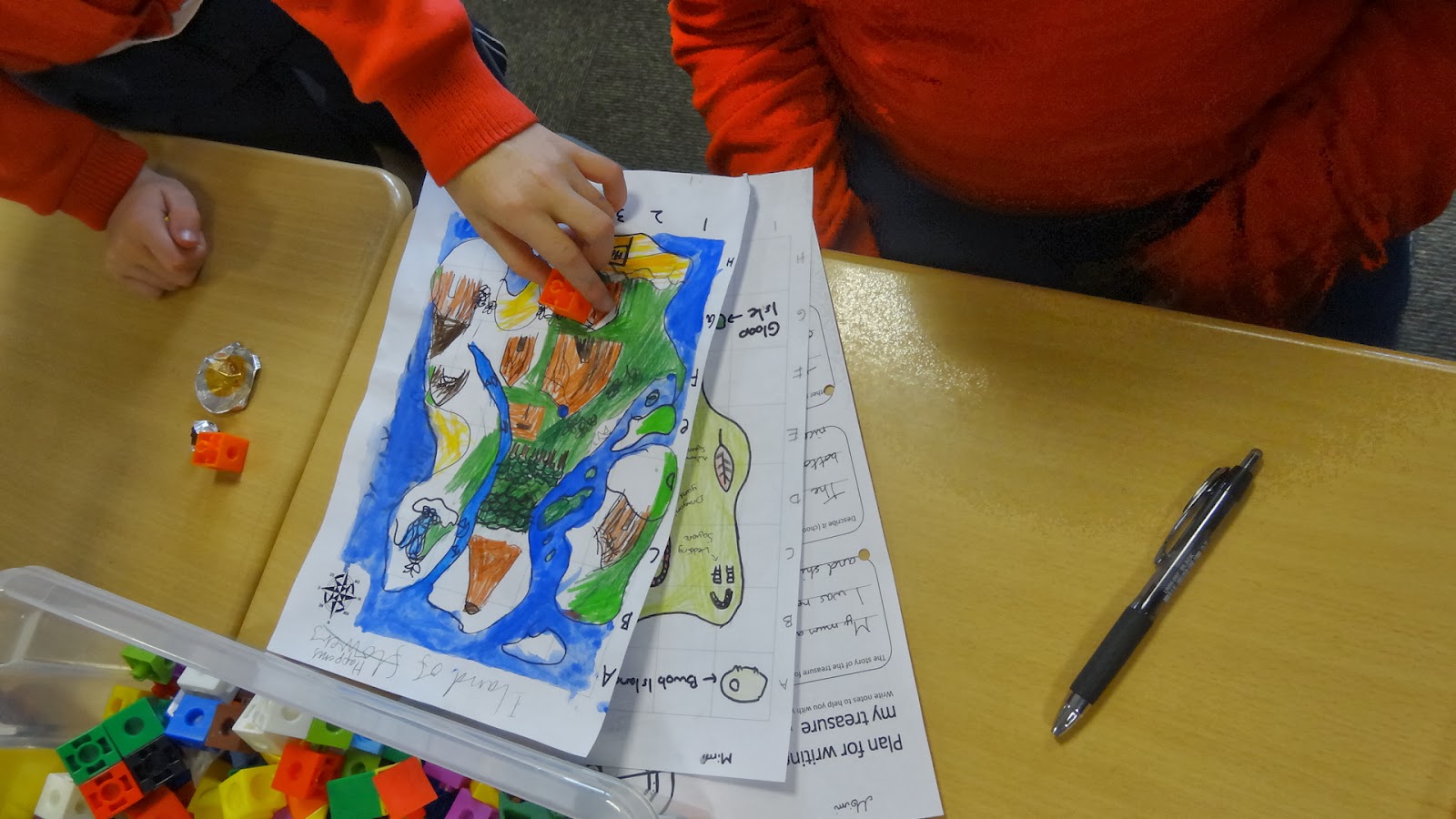
In Year 4 we've discovered some islands. (Naturally they all have buried treasure on them somewhere.) We've made careful maps of them. All the maps have coordinates, and we've used those to make a guessing game about where the treasure is buried. We started our work using a letter-number coordinate, and referring to the spaces, the squares, rather than the lines. Then we moved on to a number-number system, this time referring to the lines and where they cross.
For the treasure hunt game, first of all we secretly decide on and write down the coordinates of the treasure. Our partner then has to guess the coordinates. We say "hot" if the guess is in the squares around the buried treasure - and we mark that with a red cube. We say "warm" if it's int he squares around those, marking this with a yellow cube. And "cold" if it's anywhere else.
Sunday, 26 January 2014



Thursday, 9 January 2014
Year 4 dodecagons

Year 4 used pattern blocks each make a different regular dodecagons (= 12-sided shape). At first they were tricky to make, but some people like Ryan, Alicia and Gustavo really got into the swing of things and made more than one!


Wednesday, 8 January 2014
Tessellations in Year 4
In Year 4 we looked carefully at the six pattern block shapes.

Then we made tessellations (regular patterns that could carry on for ever in all directions) with some of them.


Then we made tessellations (regular patterns that could carry on for ever in all directions) with some of them.
Here are the tessellations we created:
Saturday, 14 December 2013
Patterns in squares in Year 4

At first it wasn't as simple as that might sound. We were getting a lot of almost-squares. Look, for instance, at this one, created on the Cuisenaire Environment -
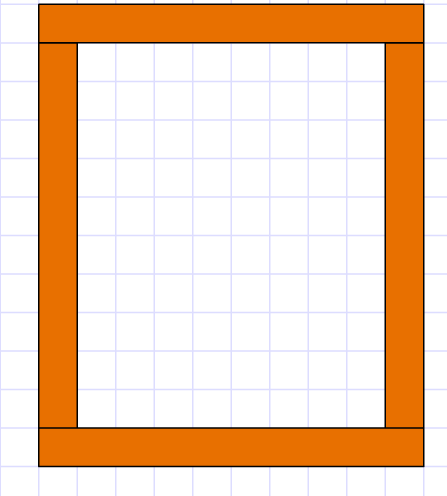
A lot of interesting patterns emerged worth following up.
It would be interesting to think of mathematical question about these shapes. With the faces for instance, how does the perimeter progress in each of the two kinds of pattern? What area of table is visible in each?
 |
| Pascal, Paloma, Parsang and Perry Perimeter |
Sunday, 24 November 2013
Lego Maths with Y6
Unusually this autumn has seen more than its fair share of wet playtimes. During these sessions, many children have been attracted to the box of Lego bricks. Watching them build and play with the bricks, they instinctively know that if they are building with 8-stud bricks, and they run out, then two 4-stud bricks will do, or a 6-stud and a 2-stud, or four 2-studs. Arrays are everywhere. They are doing maths all the time without realising.
Wanting to take advantage of this enthusiasm, I decided to investigate the numerical properties of the bricks with my Year 6 class to see what they came up with. I asked them to look for numbers and (for today) discouraged building. I encouraged recording anything they found out.
They found out evidence of factors, number bonds, arrays, divisibility, sequencing, square numbers and experienced lots of data handling and discussing the numerical properties of their bricks.
One student found out that 100 was not divisible by 8, whilst another was intent on finding patterns of square numbers using 4-stud bricks (numbers of studs and numbers of bricks).

Another group were keenly trying to find the relationship between the number of studs on top of a brick with 2 rows of studs and the holes underneath.

They could see that the number of holes was one less than one 'line' of studs. Once they organised their results and checked their ideas, it was only a small step for them to realise how to explain using maths vocabulary and then with a bit of help created a formula.
This sparked ideas in others who wanted to try and find the 'rule' if the flatter base (rather than a brick) had rows of 4 studs instead of 2. Although we ran out of time, the discussion went into the next lesson as one student was determined to explain to me how to get the answer (correctly!).

He came up with the mathematical rule and formula overnight.
Can anyone else find it too?
Wanting to take advantage of this enthusiasm, I decided to investigate the numerical properties of the bricks with my Year 6 class to see what they came up with. I asked them to look for numbers and (for today) discouraged building. I encouraged recording anything they found out.
They found out evidence of factors, number bonds, arrays, divisibility, sequencing, square numbers and experienced lots of data handling and discussing the numerical properties of their bricks.
One student found out that 100 was not divisible by 8, whilst another was intent on finding patterns of square numbers using 4-stud bricks (numbers of studs and numbers of bricks).

Another group were keenly trying to find the relationship between the number of studs on top of a brick with 2 rows of studs and the holes underneath.

They could see that the number of holes was one less than one 'line' of studs. Once they organised their results and checked their ideas, it was only a small step for them to realise how to explain using maths vocabulary and then with a bit of help created a formula.
This sparked ideas in others who wanted to try and find the 'rule' if the flatter base (rather than a brick) had rows of 4 studs instead of 2. Although we ran out of time, the discussion went into the next lesson as one student was determined to explain to me how to get the answer (correctly!).

He came up with the mathematical rule and formula overnight.
Can anyone else find it too?
Friday, 11 October 2013
This year's Forest of Factors

 |
| See more on the Year 4 blog |
Our trees made a really big Forest of Factors display for the primary corridor. As the Year 2 and Year 3 children are passing it regularly, it was a good idea to explain the display to them. We did it without using the words "factor", "multiple" or "prime" so that it would be easier for them to understand:
"Hello everyone. This is our Forest of Factors."

"1, 2, 3, 4.... 40"

"What do you notice about our pictures?"


"Number 1 is my bird. It's different to all the other numbers. If you times something by 1 it just stays the same number."

"So 1 is special, and we don't think about it with our trees and mushrooms. It's just flying up in the sky!"

"Some of the numbers are simple trees. Look at 38. 38 is 19 times 2, so we've given it two branches that finish with flowers."

"Ten is five times two."

"26 is 13 times 2."

"These ones had just two branches and two flowers."

"But some of the trees have more flowers. Like 12, and 32."

"With the mushrooms there's no two numbers that you can times together to make that number."

"Can you see a number that is a mushroom?"

"So that's our Forest of Factors. We hope you understand it a bit better now."
Wednesday, 2 October 2013
Finding prime numbers in Year 4
In Year 4 we've been looking at prime numbers this week.
Some of us have been out in the playground, using the hundred square there:
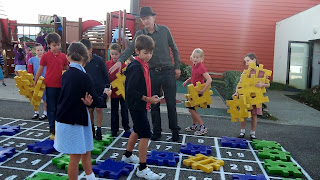

Some of us have been out in the playground, using the hundred square there:


Here's a how we did it:
Later we had a go in the classroom, using a photo of the hundred square (16 colour bitmap format):

and, on Paint, filling he numbers in the 5, 3, 7 and 2 times table with colour:


and, on Paint, filling he numbers in the 5, 3, 7 and 2 times table with colour:

And there we have it: the grey ones (except for 1) are the prime numbers!
(also blogged on the Year 4 blog)
Monday, 16 September 2013
How big is a million?

Have a look on the Year 4 blog to see exactly how big a million is, and how it could be dangerous in the classroom.
Subscribe to:
Posts (Atom)