Tuesday, 17 March 2015

ISMTF Middle School Competition

Information for ISToulouse families

Some time ago, the International School of Toulouse volunteered to host the ISMTF middle school Mathematics competition in 2015. The International Schools Mathematics Teachers Foundation (ISMTF) has been running competitions for many years and students from the International School of Toulouse have taken part in many of them

They run three competitions every year,

1. The middle school competition for 14 year old
2. The junior competition for 16 year olds
3. the senior competition for 18 year olds

Their continued success depends on schools volunteering to host the events. In recent years, students from the IST have taken part in competitions in Paris, Basel, Vienna, Milan, Luxembourg and Geneva all of which have been fabulous experiences. We hope to have many more and, as such, we are only too glad to take our turn of hosting. The competition takes place between the 27th and 29th of March 2015.

This year the competition will involve 11 students from IST in years 8 and 9 as part of a total of 117 students and 29 visiting teachers from schools from Europe and beyond. We are delighted to welcome all of the schools some of who are coming from as far a field as India, Dubai, Cairo and Tunisia.

Huge Organisiation

Obviously the event has taken a huge amount of preparation lead by the Mathematics department at the school with terrific support from the whole school community. We are so very grateful for all of the support we have from our colleagues, students and parent and governing body. It has been a wonderful coming together of the whole school to work towards a truly international and hopefully very successful event that shows the value of goodwill within the school community. I expect to spend a good deal of time saying thank you after the event and paying back a considerable debt of support that I will owe.

What does it involve?

  • This competition will involve 117 students between the ages of 11 and 14 in two competitions.
  • The International School of Toulouse has also entered teams and will provide substitutes for any absentees from other schools.
  • Students come from International schools in Europe and beyond.
  • Students will stay with host families from the International School of Toulouse and Coaches will stay in a hotel in Toulouse.
  • The first competition on Saturday takes place in teams of three where students will represent the school they come from.
  • The second competition on Sunday involves students competing in teams of 6 where students will be mixed in teams with students from different schools.
  • On the Saturday afternoon, there will be an excursion to the Airbus A380 final assembly line and the Aeroscopia aviation museum.
  • We are delighted to welcome author Simon Singh as a guest speaker on Saturday where he will talk about his book, Fermat's last Theorem, which is a story of great local significance.

Host Families

A significant part of the experience is that the visiting students are hosted by families rom our school community. This was always a tall order given how small a school we are, but with the very able Friends of IST and the very obliging parent community we are delighted to be able to offer this experience to students. This also allows the school community to be more involved with the event. Thank you to all of the families who are able to help us with this. We are very grateful.

Simon Singh

We are particularly pleased to welcome author Simon Singh to the school for that weekend. He is best know to mathematicians as the author of 'Fermat's last Theorem' which tells the wonderful story of this enigmatic mathematical problem that local mathematician Pierre de Fermat brought to the world's attention and was finally proven by mathematician Andrew Wiles nearly 400 years later. Some students at the IST will have the opportunity to listen to Simon Singh Speak about his latest book 'The Simpsons and their mathematical secrets', while he is here.

Information for participating schools is hosted here. 

Thursday, 8 January 2015

Cuisenaire rod patterns in Year 4

Last term, in pairs, Year4 had a go at creating sequences of cubes and understanding them. This week they've been trying a similar thing with Cuisenaire rods. And what a great lot of sequences they've created!

More challenging perhaps, is understanding the patterns and how they grow - and this means understanding them mathematically.
Some of the students got straight into the number crunching:
oops! - this one is not quite right!
Others wanted to draw their sequence first:
They had to think hard about the patterns:


Some of the students were willing to talk about their patterns:


Sunday, 21 December 2014

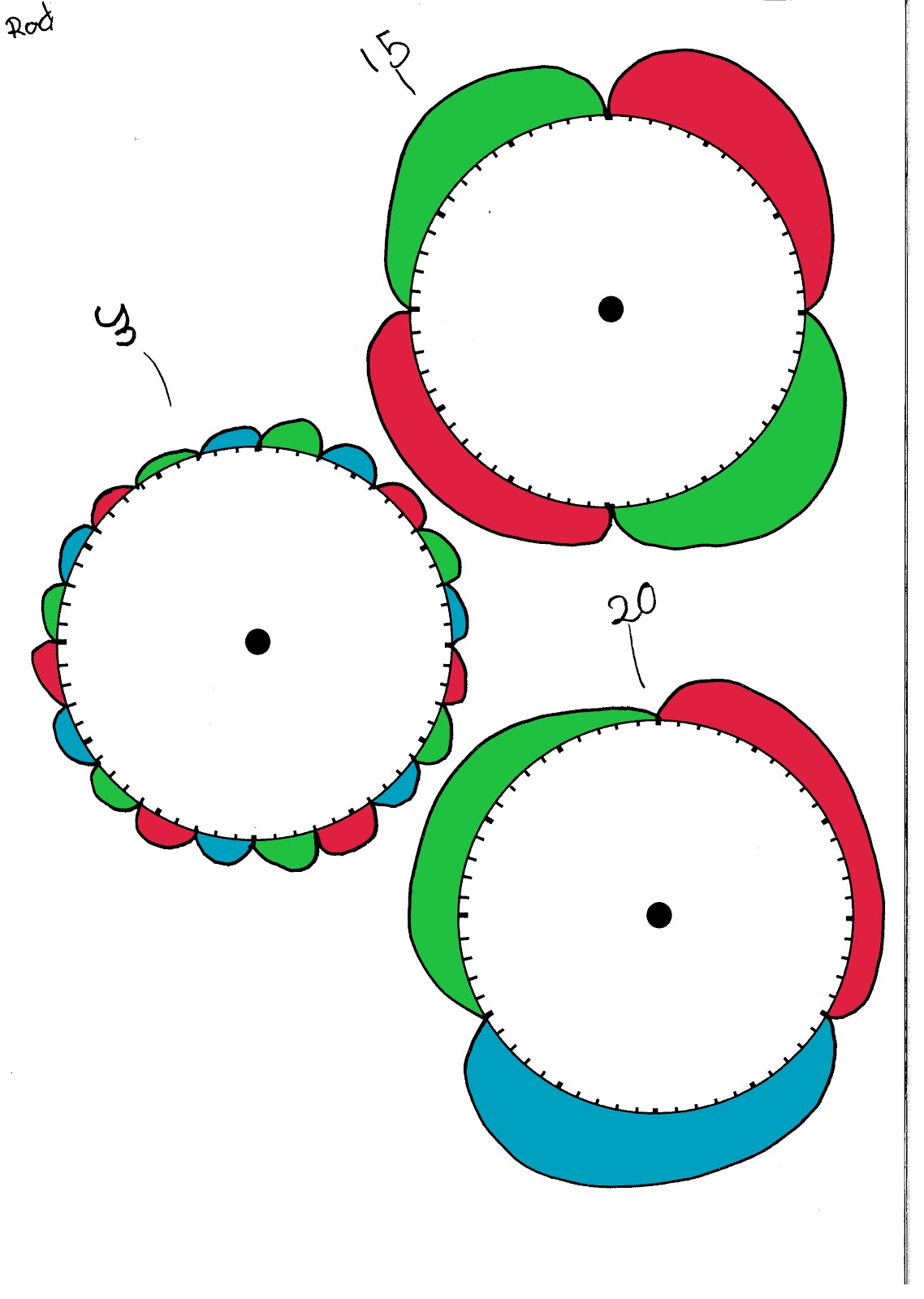
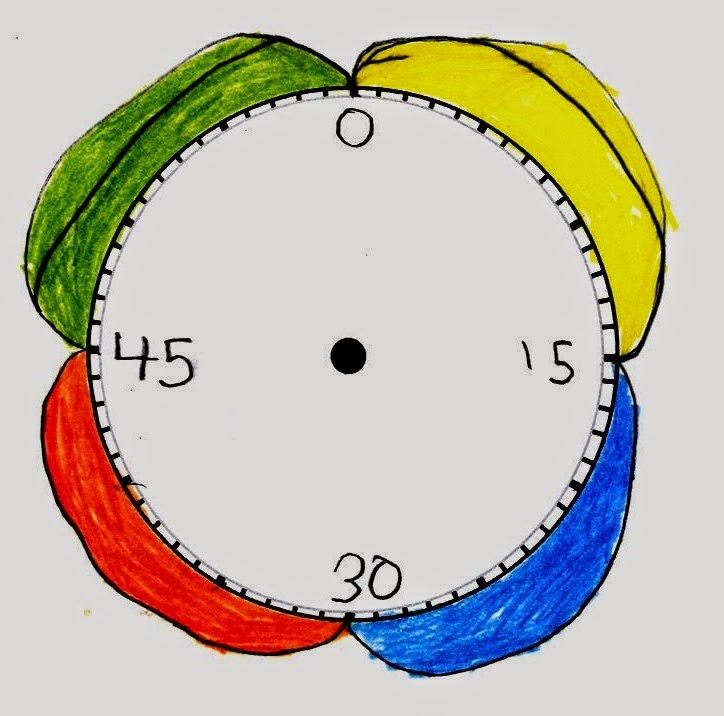
Clock flowers in Year 4

In the course of our counting circle sessions we looked at clock counting (mod 60 counting).
We took this a bit further. using a Scratch project to generate these easily. 

It was a great opportunity for mathematical noticing, reasoning and claim-making. For instance
  1. The odd numbers go to every stop


    1. I do not think so, because 15 is a odd number and it does not meet every stop
and

I notice that all of the prime number under 22 meet all of the numbers under 59 on the clock.It looks so cool!

  1. What you say is almost true, Justus, but what about 2, 3 and 5?

    What do you think?
  2. 3 5 7 do not visit all of the numbers because are the factors of 60
The class also had a go at creating some of the "clock flowers" by hand:
and looked at the same thing in terms of division:


There's a lot more mileage in these clock patterns. Who knows where we'll take it next time... maybe string patterns?

Thursday, 11 December 2014

Fairground Games

Year 9 have completed their annual probability project where they design, test and run a ‘fairground’ for visiting year 6 students. It is always great fun and this year was no exception. The exercise is all about experimental probabilities. By designing games carefully, you should be able to predict that more people will lose a game than win it. With theoretical games, you can calculate it. The challenge is to make a game that people want to play, that is possible to win, but that people are mostly likely to lose so the stall holder wins in the end. So it is great to put these games to real test. Year 6 obliged and were very discerning with their money. Some of them went home with more than they came with, but on balance the fairground won - just. This years winners were Nicholas and Kieran whose brave ‘wet sponge throw’ (it was cold outside) won the most money. A direct hit in the face was required to win, but apparently the punters felt a body hit was worth the cost! Great design and aesthetics from the ‘Jungle challenge’ and ‘jungle hoops’ and lots of terrific ideas involving everything from Nerf guns and roulette wheels! A terrific event - well done to all who took part! 

Counting Circles in Year 4

We've been trying out "Counting Circles" in Year 4, and it's starting to get into its stride. Obviously there are lots of ways to count, but we've begun to do it in a very particular way (here described by John Golden, based on Sadie Estrella's lessons). This, for us, involves sitting in a circle, and counting from a chosen number in a certain-sized jump. On the first day we started from zero and jumped up in twos, with the teacher writing down the steps on the whiteboard.
Day 1
Easy enough. Then at a certain point (52 on the first day) we stop and the teacher says:
"What number would Marie (for example) be who's three people after 52? Think about it and put your hand up when you've come up with an answer." 
Then the good bit comes: the explanation. "Who could share the way they worked out that it was 58?"
Usually there are a number of explanations, and a number of ways of getting to the answer. Children explain their thinking, and we note it down on the whiteboard.
Day 2
Day 3
Day 4
Day 5
We've been doing this for perhaps five or ten minutes at the start of some of our lessons, then we leave it and go onto something else. 

This last week we've been looking at time on the analogue clock, so it made sense to do a bit of clock counting, following the way the minutes go ("counting in mod 60"):
Day 9: Clock counting
(Apologies - very shaky video!)

The next day was clock counting with jumps of eight (it took two times round the clock to get back to zero).

The day after, jumps of eleven:
Day 11
There were lots of great ways of getting the person three jumps on's number. James was looking at the vertical pattern all the way across. Alya spotted a diagonal pattern. Rod added three to each digit, rembering that the 6 for sixty became zero. And Samyak added 33 and knew that 68 is actually just 8 in clock counting.

It's early days yet. It's been a good moment for us to share our reasoning and see that we often know more than one good method. We'll keep going with it. We'll try new jumps, and also work on not correcting each other's mistakes, and at listening to each other's explanations really carefully.

PS. See the Year 4 blog to see how we later continued with the clock counting patterns on paper to create Clock Flowers.

Thursday, 4 December 2014

Seeing through these problems

At our school in Toulouse, the classrooms have one wall that is almost entirely glass and big double glass doors on the opposite wall. This makes for a lovely light a spacious room but sometimes leaves us short of wall space! Imagine then my delight and discovering 'Window Markers!' My classroom walls are now becoming adorned with lovely maths problems! Here are a couple of problems that are on the door at the moment....


I am sure many have seen this problem before, but Mathematics is never going to run out of things for us to spend more time looking at. I picked this up from a friend's daughter's homework they were asking me about. The problem has a couple of particular fascinations for me based on playing with it myself and putting it on my classroom door.

1. That there are some quite different ways to approach it
2. That there is significance difference between asking students or a particular unknown length and a more general 'given the diagram, what else can you tell me that is true?' approach

That last thought has occupied me for a while....

Here is another one!
This took even more thought! and even prompted +Simon Gregg to write this blog post when he first saw it!

No solutions here as that would spoil the fun!

Wednesday, 3 December 2014

Estimation challenges

Children in Year 4 have had a piece of homework: devise an estimation challenge for the rest of Year 4. You can see the great challenges by clicking here. They've also been trying to answer each others' questions.

This came after we've spent a fair bit of time on Andrew Stadel's great site estimation180.com, recording our upper and lower limits and estimation on the Google docs for some of the challenges. There's something really engaging about being presented with these mystery quantities, amounts, numbers and measurements, and trying to zero in on a reasonably accurate answer.

The Year 4 students produced a real variety of challenges: measuring ones like how tall is Milly, the world's smallest dog?
Ones involving part of a known quantity, like how many matches are left in the matchbox?
And lots of counting challenges, including some where you need to sample part of the picture and then scale it up to account for the whole picture, like Hama bead estimation.
It's really great how families have helped with this, with the maths, and with filming and photographing, and also how everyone has been able to write their post, upload their pictures that give clues and also links or videos that reveal the answer. And of course the estimates in the comments have been great too! If you'd like to have a go, please do. No peeking though!

Tuesday, 7 October 2014

Patterns of cubes - the first in the sequence

Looking at patterns and how they grow is something we've done lots before. But this time in Year 4 we took particular time over something different: what exactly the first step should be.

Look at this pattern here, a pattern of "C" shapes:
We had a long discussion about that first single cube. Did it really belong in the sequence? Some thought yes, some no. We didn't really come to a definite conclusion, but the good thing was that we were able to explain our reasoning one way or the other.

For instance with this pattern of "H"s:
The two girls were more than happy to explain their thinking:
Click on picture to see video
How about these other sequences? Do you think the first one is right? 
You can see more of this Year 4's mathematics learning on the Y4 blog.

Friday, 20 June 2014

A Square of Cubes in Year 4


For instance, with n=3, the first three cubes
 - here made in Cuisenaire rods - can be reassembled into a square:
The square is six units wide, six being the third triangle number.

The puzzle then, was to make the cubes and then make a square from them. The class managed that successfully and it might have finished there, but when the following day they were asked to create a growing pattern of their own in Cuisenaire rods
and bigger - swallowing up all the Cuisenaire rods in the school, until they had created a monster:
The next day, while the rest of the class explained their own patterns, the four girls enthused about their creation.

It was time to have a closer look at the patterns of numbers hidden inside this huge square:
square numbers
triangle numbers
And then, to round it all off, a display outside the class:
with the invitation to make the cubes and the squares from the same rods:
We rounded it all off by inviting the Year 2s and Year 3s to find out what it was all about.  The four girls explained their creation brilliantly!