Showing posts with label cuisenaire rods. Show all posts

Thursday, 8 January 2015

Cuisenaire rod patterns in Year 4

Last term, in pairs, Year4 had a go at creating sequences of cubes and understanding them. This week they've been trying a similar thing with Cuisenaire rods. And what a great lot of sequences they've created!

More challenging perhaps, is understanding the patterns and how they grow - and this means understanding them mathematically.
Some of the students got straight into the number crunching:
oops! - this one is not quite right!
Others wanted to draw their sequence first:
They had to think hard about the patterns:


Some of the students were willing to talk about their patterns:


Friday, 20 June 2014

A Square of Cubes in Year 4


For instance, with n=3, the first three cubes
 - here made in Cuisenaire rods - can be reassembled into a square:
The square is six units wide, six being the third triangle number.

The puzzle then, was to make the cubes and then make a square from them. The class managed that successfully and it might have finished there, but when the following day they were asked to create a growing pattern of their own in Cuisenaire rods
and bigger - swallowing up all the Cuisenaire rods in the school, until they had created a monster:
The next day, while the rest of the class explained their own patterns, the four girls enthused about their creation.

It was time to have a closer look at the patterns of numbers hidden inside this huge square:
square numbers
triangle numbers
And then, to round it all off, a display outside the class:
with the invitation to make the cubes and the squares from the same rods:
We rounded it all off by inviting the Year 2s and Year 3s to find out what it was all about.  The four girls explained their creation brilliantly!

Wednesday, 23 April 2014

Five Rectangles

In Year 4 we've been looking at a puzzle, taken from Gary Antonick's 'Numberplay' in the New York Times:
Create a set of five rectangles that have sides of length 1, 2, 3, 4, 5, 6, 7, 8, 9 and 10 units.
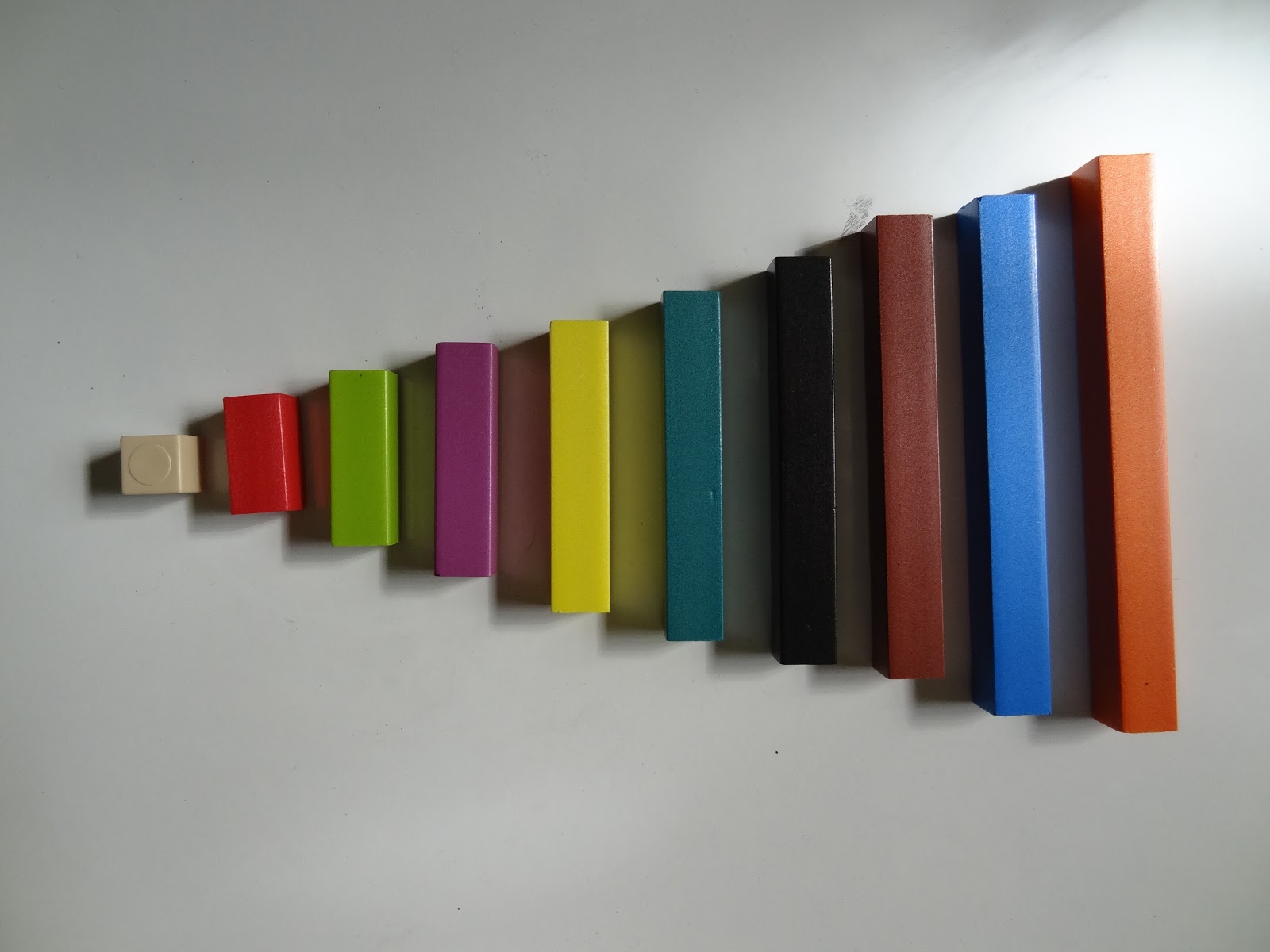
The really quick and easy way to explore this is with Cuisenaire rods:


After we'd found five rectangles with those side lengths, we recorded them using the Cuisenaire Environment:


Here are more pictures:


Then we started looking at the area the rectangles covered.


We got total areas of
120, 121, 123, 125, 130, 154, 161 and 184.

Next question: what is the biggest possible area?

Alicia answered this - use the biggest side lengths on the same rectangles:

Area = 190
Can you see why this is the maximum?


And then, what is the smallest possible area?

Mimi answered this one - use biggest and smallest lengths on the same rectangle:
Area = 110
Can you see why this is the minimum?


This is a great investigation - manageable, easy to understand, and susceptible to taking off in many directions. We didn't try to see how many possible ways of making the rectangles there are - that was a step too far.

But just seeing some of the ways was worthwhile. It works well because the rods and the numbers 1 to 10 are easy to grasp. And the maths it takes us into is worth it - length, area, 2 X 3 = 3 X 2, multiplication facts, addition of five numbers... And then a bit of more abstract thinking - what would the maximum and minimum be, and why.

It may be the first time a class has tackled this particular puzzle. We can certainly recommend it to other classes!

We rounded this investigation off with a small puzzle: 
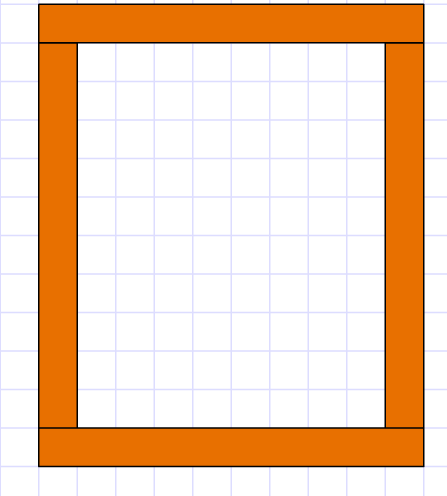
Make these rectangles, and then see if you can make a square by putting them together:
 1x6 4x7 5x8 3x9 2x10
 3x6 4x7 2x8 1x9 5x10 
1x2 4x5 3x8 7x9 6x10
 1x2 4x6 3x7 8x9 5x10


Friday, 7 March 2014

More maths with Cuisenaire rods in Year 4

We've posted some of our work with Cuisenaire rods here already (see for instance our work on patterns in squares). Since then, we've used them in lots of other ways. Click on the headings to get more detail on the Year 4 blog.

Cuisenaire multiplication square

This was great fun to make, and the image of it has been a great resource to refer to:


Forgetting about square roots (not)

Not usually in the Year 4 (9 and 10 year old) curriculum, so we said forget about it, but of course this paradoxical injunction worked magic! Topped off with a little work on the differences of squares.


Algebra with Cuisenaire rod sums

This seems to be the ideal way to introduce the idea of using a letter instead of a number. (And thanks to Don Steward for the inspiration.)


Rozenn and Pythagoras

When Rozenn came in with something her dad had shown her - Pythagoras Theorem - the rods were the ideal way of quickly seeing that for the 3-4-5 triangle the theorem was right.


 Of course this is Secondary school work really, but just as in art we look at work by, say, Paul Klee, or in music we listen to adult musicians and composers, why shouldn't we look ahead and marvel a little in maths too?!

Saturday, 14 December 2013

Patterns in squares in Year 4


We been having a look at patterns of squares using Cuisenaire rods in Year 4, starting by just making any design featuring as square.

At first it wasn't as simple as that might sound. We were getting a lot of almost-squares. Look, for instance, at this one, created on the Cuisenaire Environment -

At first it fooled a lot of us! It's got at ten on each side...

A lot of interesting patterns emerged worth following up.


It would be interesting to think of mathematical question about these shapes. With the faces for instance, how does the perimeter progress in each of the two kinds of pattern? What area of table is visible in each?

Pascal, Paloma, Parsang and Perry Perimeter
(Also published on the Year 4 blog.)

Thursday, 6 June 2013

Make a pattern

There is a wonderful site called http://visualpatterns.org/ where you can view all sorts of visual patterns that people have submitted. The idea is to work out the next in the series, and then to see how each step is created so that you could predict the 43rd one.

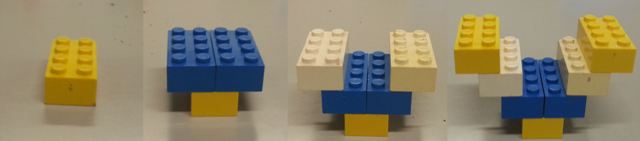
In Year 5G we tried out some of the simpler ones, like this one, submitted by Nic Doran:

How many Lego pieces are in step 43?
We'd already been looking at some sequences, like:


but it was time to create our own:


Here are some of our patterns:


We then set about understanding the pattern mathematically:
  • How does the pattern grow?
  • What number does it grow by each time?
  • What number is there in each step of the pattern?
  • Can you write this with algebra?
  • Can you work out what the 43rd step in the series would be?
We began to answer some of these questions:


The next day we documented our patterns on squared and isometric paper, and tried to understand the mathematics involved. Here's an example on the whiteboard: