Showing posts with label pattern. Show all posts

Thursday, 8 January 2015

Cuisenaire rod patterns in Year 4

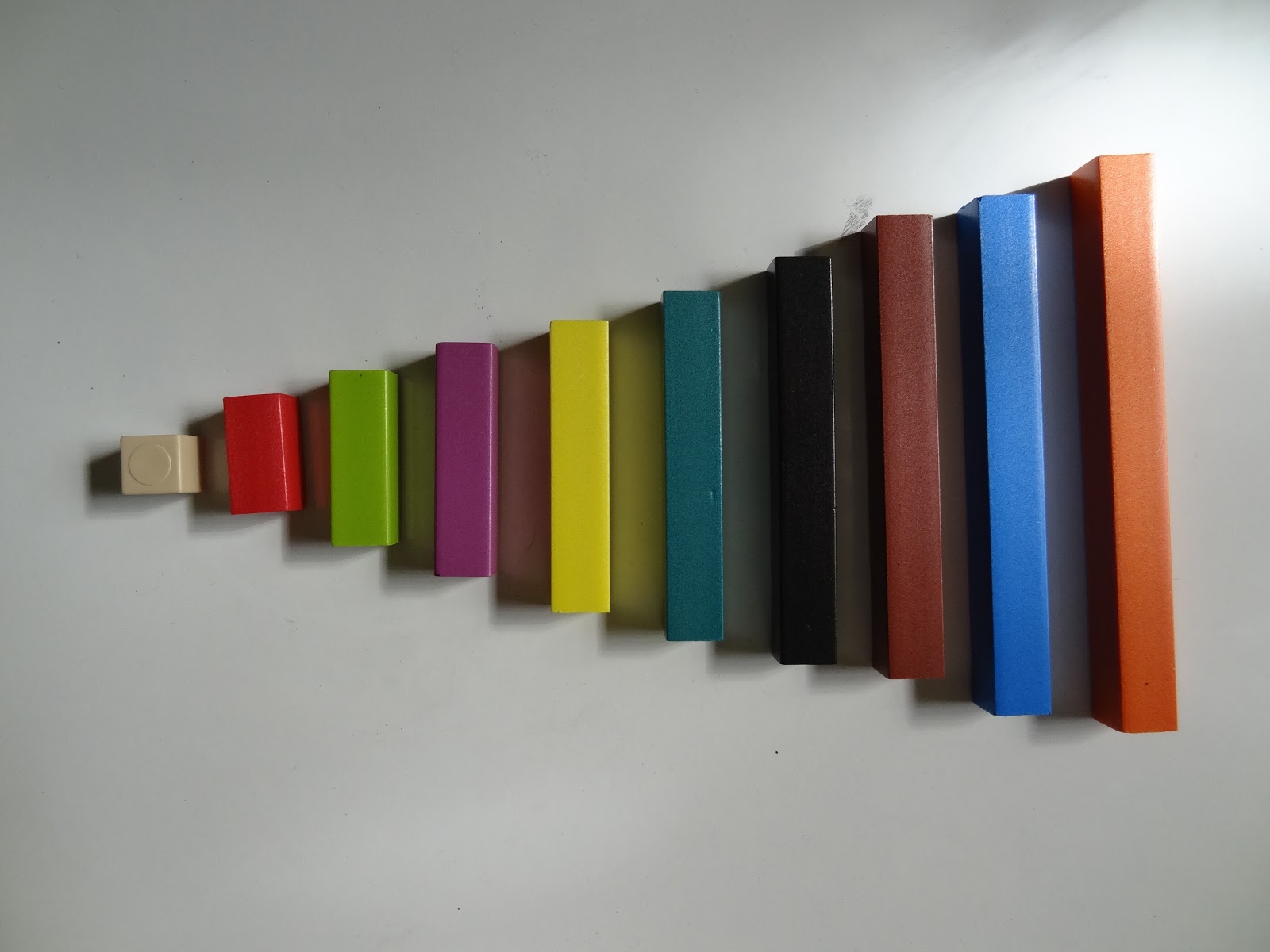
Last term, in pairs, Year4 had a go at creating sequences of cubes and understanding them. This week they've been trying a similar thing with Cuisenaire rods. And what a great lot of sequences they've created!

More challenging perhaps, is understanding the patterns and how they grow - and this means understanding them mathematically.
Some of the students got straight into the number crunching:
oops! - this one is not quite right!
Others wanted to draw their sequence first:
They had to think hard about the patterns:


Some of the students were willing to talk about their patterns:


Tuesday, 7 October 2014

Patterns of cubes - the first in the sequence

Looking at patterns and how they grow is something we've done lots before. But this time in Year 4 we took particular time over something different: what exactly the first step should be.

Look at this pattern here, a pattern of "C" shapes:
We had a long discussion about that first single cube. Did it really belong in the sequence? Some thought yes, some no. We didn't really come to a definite conclusion, but the good thing was that we were able to explain our reasoning one way or the other.

For instance with this pattern of "H"s:
The two girls were more than happy to explain their thinking:
Click on picture to see video
How about these other sequences? Do you think the first one is right? 
You can see more of this Year 4's mathematics learning on the Y4 blog.

Friday, 20 June 2014

A Square of Cubes in Year 4


For instance, with n=3, the first three cubes
 - here made in Cuisenaire rods - can be reassembled into a square:
The square is six units wide, six being the third triangle number.

The puzzle then, was to make the cubes and then make a square from them. The class managed that successfully and it might have finished there, but when the following day they were asked to create a growing pattern of their own in Cuisenaire rods
and bigger - swallowing up all the Cuisenaire rods in the school, until they had created a monster:
The next day, while the rest of the class explained their own patterns, the four girls enthused about their creation.

It was time to have a closer look at the patterns of numbers hidden inside this huge square:
square numbers
triangle numbers
And then, to round it all off, a display outside the class:
with the invitation to make the cubes and the squares from the same rods:
We rounded it all off by inviting the Year 2s and Year 3s to find out what it was all about.  The four girls explained their creation brilliantly!

Sunday, 24 November 2013

Lego Maths with Y6

Unusually this autumn has seen more than its fair share of wet playtimes.  During these sessions, many children have been attracted to the box of Lego bricks. Watching them build and play with the bricks, they instinctively know that if they are building with 8-stud bricks, and they run out, then two 4-stud bricks will do, or a 6-stud and a 2-stud, or four 2-studs.  Arrays are everywhere.  They are doing maths all the time without realising.

Wanting to take advantage of this enthusiasm, I decided to investigate the numerical properties of the bricks with my Year 6 class to see what they came up with.  I asked them to look for numbers and (for today) discouraged building.  I encouraged recording anything they found out.

They found out evidence of factors, number bonds, arrays, divisibility, sequencing, square numbers and experienced lots of data handling and discussing the numerical properties of their bricks.

One student found out that 100 was not divisible by 8, whilst another was intent on finding patterns of square numbers using 4-stud bricks (numbers of studs and numbers of bricks).


Another group were keenly trying to find the relationship between the number of studs on top of a brick with 2 rows of studs and the holes underneath.   


They could see that the number of holes was one less than one 'line' of studs.  Once they organised their results and checked their ideas, it was only a small step for them to realise how to explain using maths vocabulary and then with a bit of help created a formula.
This sparked ideas in others who wanted to try and find the 'rule' if the flatter base (rather than a brick) had rows of 4 studs instead of 2.  Although we ran out of time, the discussion went into the next lesson as one student was determined to explain to me how to get the answer (correctly!).

He came up with the mathematical rule and formula overnight.  
Can anyone else find it too?

Thursday, 6 June 2013

Make a pattern

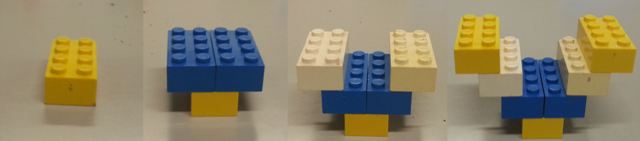
There is a wonderful site called http://visualpatterns.org/ where you can view all sorts of visual patterns that people have submitted. The idea is to work out the next in the series, and then to see how each step is created so that you could predict the 43rd one.

In Year 5G we tried out some of the simpler ones, like this one, submitted by Nic Doran:

How many Lego pieces are in step 43?
We'd already been looking at some sequences, like:


but it was time to create our own:


Here are some of our patterns:


We then set about understanding the pattern mathematically:
  • How does the pattern grow?
  • What number does it grow by each time?
  • What number is there in each step of the pattern?
  • Can you write this with algebra?
  • Can you work out what the 43rd step in the series would be?
We began to answer some of these questions:


The next day we documented our patterns on squared and isometric paper, and tried to understand the mathematics involved. Here's an example on the whiteboard:


Thursday, 23 May 2013

Triangle Mysteries

Here's a great pattern investigation, that got all of us in Year 5G thinking about patterns in a fresh way - fresh because we'd not come across anything quite like it before.

The activity comes from Steve Humble, and appears in the New York Times. We didn't look at the random aspect of it; we concentrated on what we could see in terms of patterns and rules.

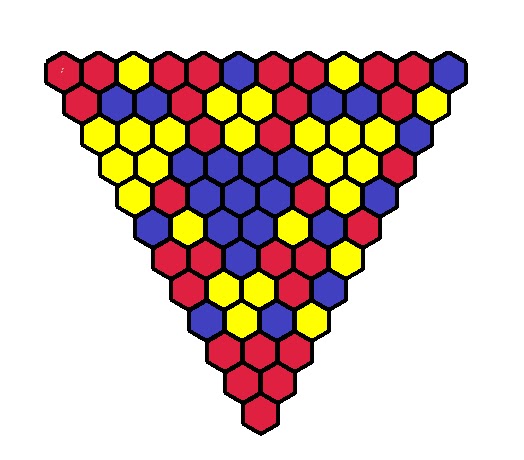
The idea is to to start off with an empty grid like this:
You could download it yourself and have a go...
opening it in Paint. Each hexagon in the top row is filled with blue, red or yellow.

Then for the second row these are the rules:
  1. If the two hexagons above are the same colour as each other, then the hexagon below is that colour. 
  2. If the two hexagons above are different colours, then the hexagon below is the third colour.

Here are some of our patterns:


The patterns are great, but it was the thinking that was the most interesting part!

Here are some of our thoughts, our general statements, about the patterns. Some of them are not in fact true, some of them need investigation...


William: With some of them you turn them and you get the same pattern.

Sophia: There's often a triangle in the pattern.

Jessica: Sometimes you can guess what the colour will be at the bottom.

Chris: If you start with just red and yellow the bottom hexagon will be blue. (Is this always true??)

Christophe: The only one that doesn't have a triangle of colour in it is mine:
Florian: You never know what the colour will be at the bottom.

Jessica: You can tell if it's done correctly because usually there are downward-pointing triangles, never upward-pointing triangles.

Jessica: There is usually a pattern but not always.

Anna: The pattern still works when it is rotated.

Anna: Some of the shapes are symmetrical.


The next day, some of us had time to model a few triangle mysteries in other materials:


and in the playground -