Showing posts with label factors. Show all posts

Wednesday, 10 February 2016

Thought Plants

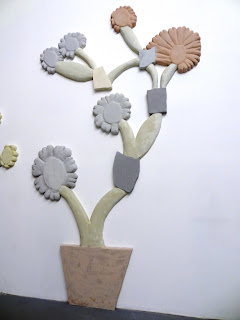
In Toulouse, at the Préface Gallery, two artists Charlie Youle and Bevis Martin are exhibiting some beautiful sculptures, "Thought Plants".
The Préface website says:
Thought Plants présente un ensemble de sculptures murales réalisées à partir de dessins de plantes faits par des enfants. Les dessins originels sont en réalité issus d’une méthode de calcul pédagogique et ludique destinée à faciliter l’apprentissage des mathématiques. Ainsi, derrière une représentation de la nature Bevis et Charlie nous donnent à voir la relecture d’un motif oscillant entre la spontanéité enfantine et la rigueur mathématique d’un algorithme.
The pictures that the artists based their work on were factor trees featured on this blog. In fact, that's where they encountered the trees! Mr Gregg was amazed when he first heard from the artists, who he'd not met before, about the project.
Miss Ash and Mr Gregg went to see the private view to open the exhibition. It was wonderful to see how the 2D shapes created by our students had been lovingly recreated in 3D in pastel shades that gave them a sense of being carved in colourful stone.
 In the basement there was more work based on a mathematical theme:
Miss Ash talking with Charlie Youle
The artists with Mr Gregg

Back in 2013 we posted about the factor trees that the Year 5s had created.
It was surprising and wonderful to see them being given a new life as artworks!

UPDATE

Charlie, Bevis and their daughter came to visit us at IST today - see the Year 4 blog.

Sunday, 21 December 2014

Clock flowers in Year 4

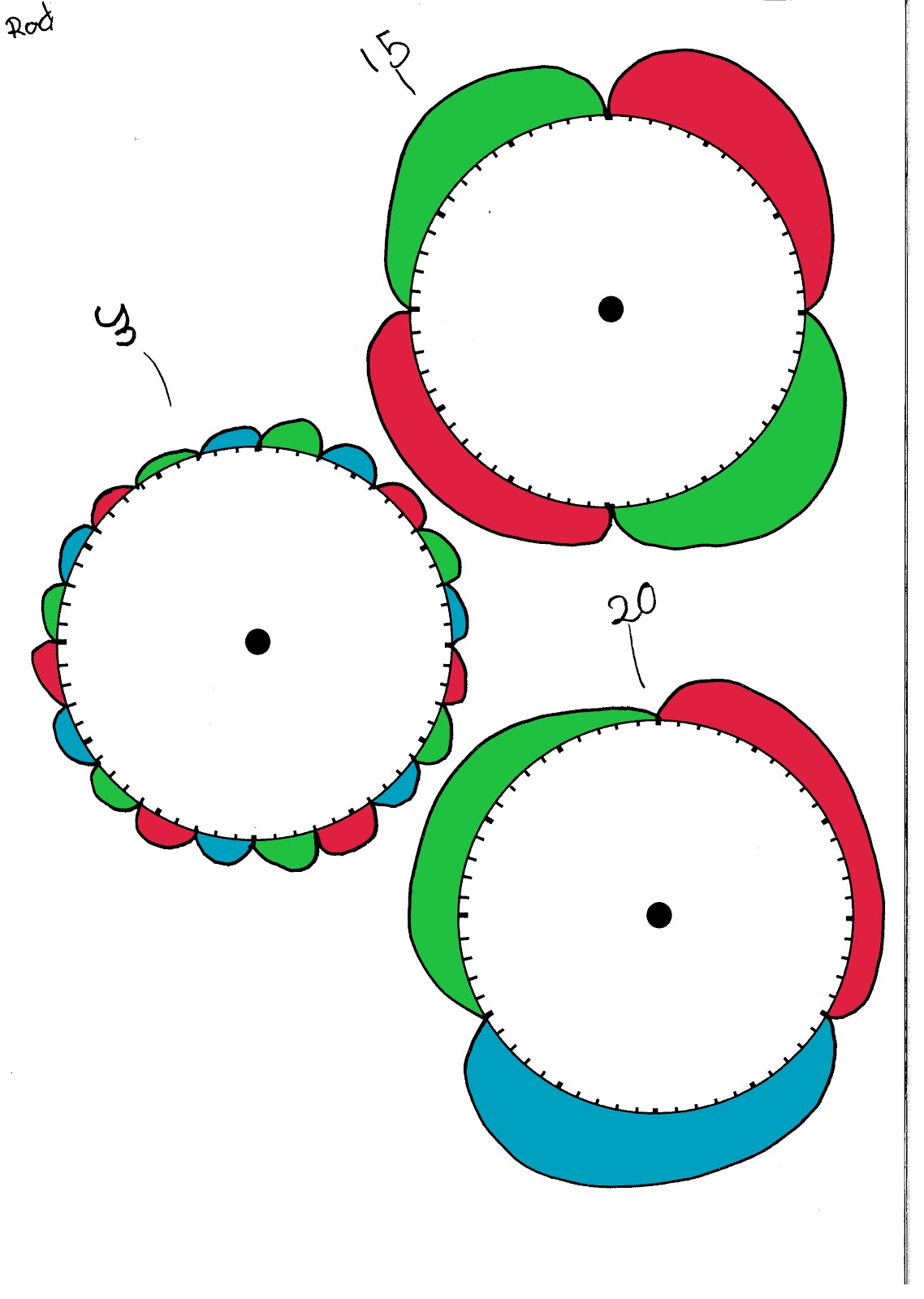
In the course of our counting circle sessions we looked at clock counting (mod 60 counting).
We took this a bit further. using a Scratch project to generate these easily. 

It was a great opportunity for mathematical noticing, reasoning and claim-making. For instance
  1. The odd numbers go to every stop


    1. I do not think so, because 15 is a odd number and it does not meet every stop
and

I notice that all of the prime number under 22 meet all of the numbers under 59 on the clock.It looks so cool!

  1. What you say is almost true, Justus, but what about 2, 3 and 5?

    What do you think?
  2. 3 5 7 do not visit all of the numbers because are the factors of 60
The class also had a go at creating some of the "clock flowers" by hand:
and looked at the same thing in terms of division:


There's a lot more mileage in these clock patterns. Who knows where we'll take it next time... maybe string patterns?

Sunday, 24 November 2013

Lego Maths with Y6

Unusually this autumn has seen more than its fair share of wet playtimes.  During these sessions, many children have been attracted to the box of Lego bricks. Watching them build and play with the bricks, they instinctively know that if they are building with 8-stud bricks, and they run out, then two 4-stud bricks will do, or a 6-stud and a 2-stud, or four 2-studs.  Arrays are everywhere.  They are doing maths all the time without realising.

Wanting to take advantage of this enthusiasm, I decided to investigate the numerical properties of the bricks with my Year 6 class to see what they came up with.  I asked them to look for numbers and (for today) discouraged building.  I encouraged recording anything they found out.

They found out evidence of factors, number bonds, arrays, divisibility, sequencing, square numbers and experienced lots of data handling and discussing the numerical properties of their bricks.

One student found out that 100 was not divisible by 8, whilst another was intent on finding patterns of square numbers using 4-stud bricks (numbers of studs and numbers of bricks).


Another group were keenly trying to find the relationship between the number of studs on top of a brick with 2 rows of studs and the holes underneath.   


They could see that the number of holes was one less than one 'line' of studs.  Once they organised their results and checked their ideas, it was only a small step for them to realise how to explain using maths vocabulary and then with a bit of help created a formula.
This sparked ideas in others who wanted to try and find the 'rule' if the flatter base (rather than a brick) had rows of 4 studs instead of 2.  Although we ran out of time, the discussion went into the next lesson as one student was determined to explain to me how to get the answer (correctly!).

He came up with the mathematical rule and formula overnight.  
Can anyone else find it too?

Friday, 11 October 2013

This year's Forest of Factors


Following on from last year's post Important Factors, and after our work finding prime numbers with Cuisenaire rods and in the playground, Year 4 had a go at making prime factor trees this year. Here's our Forest of Factors:

See more on the Year 4 blog
Our trees made a really big Forest of Factors display for the primary corridor. As the Year 2 and Year 3 children are passing it regularly, it was a good idea to explain the display to them. We did it without using the words "factor", "multiple" or "prime" so that it would be easier for them to understand:

 "Hello everyone. This is our Forest of Factors."


"1, 2, 3, 4.... 40"


"What do you notice about our pictures?"


"Number 1 is my bird. It's different to all the other numbers. If you times something by 1 it just stays the same number."


"So 1 is special, and we don't think about it with our trees and mushrooms. It's just flying up in the sky!"


"Some of the numbers are simple trees. Look at 38. 38 is 19 times 2, so we've given it two branches that finish with flowers."


"Ten is five times two."


"26 is 13 times 2."


"These ones had just two branches and two flowers."


"But some of the trees have more flowers. Like 12, and 32."


"With the mushrooms there's no two numbers that you can times together to make that number."


"Can you see a number that is a mushroom?"


"So that's our Forest of Factors. We hope you understand it a bit better now."

Monday, 4 February 2013

Important factors

People normally draw factor trees like this:
This isn't right in three ways:
  1. First of all, it should be a tree that goes up and actually looks like a tree.
  2. As the prime factors are so important, they should stand out.
  3. And  - the trees should be a bit more beautiful than this.
We started off in Year 5 looking at factors using the Cuisenaire rods, to make the factor walls of numbers. This makes what a factor is so clear:


Then we drew some different factor trees to investigate the question "What different factor trees can you make for 96?" -


Next, we thought about what mathematical questions about prime numbers we could investigate. Here are some of them:

Ella-May - Do all numbers have a two and a three as one of their prime factors?

Mr Gregg - Are there any other numbers less than 100 with six prime factors?


Sophie - Would an odd number have as many prime factors as an even number?

William - Do bigger numbers have more prime factors?

Harry - Do bigger numbers have bigger prime factors?

Some children suggested we make a huge forest of trees for lots of numbers. Here's part of it:


You can see a bigger version here.

At the same time we played a game, Ocean of Primes, adapted from the nrich Factor Track:

(You can get this as a Word document here. Best to scale it up to A3 when you print it.)


To round off this term's work on factorisation we looked at a great book, Richard Evan Schwartz's You Can Count on Monsters


In this book, all the prime numbers are monsters with particular shapes:

Two

Three
Five
Seven
Other numbers have designs made up of these ones. For instance, here's 14:

14 has 7 and 2 as prime factors, so they're in the picture
We had a good look at the book and the poster:

After we'd absorbed what was going on, we created some of our own in a similar style:
Each has the prime factors of the number illustrated:
Anna: 24 has the prime factors 3, 2, 2 and 2
Emily: 104 has 13, 2, 2 and 2 as prime factors
Sophie: The prime factors of 144 are 3, 2, 2, 3, 2, 2
UPDATE - FEBRUARY 2016 - THOUGHT FLOWERS