Monday, 16 September 2013

How big is a million?

We've been talking about the dinosaurs in Year 4, which has involved us in some pretty big numbers. For instance, the last dinosaurs died out 65 million years ago.

Have a look on the Year 4 blog to see exactly how big a million is, and how it could be dangerous in the classroom.


Tuesday, 2 July 2013

Mirror Dancing

For a number of years we have run this annual mirror dance activity at the International School of Toulouse, but this year we decided to make a bit more of an event of it! I first got the idea from a Workshop run by Anne Watson at the UK based ATM conference a few years ago!


The idea is simple! In groups of two or more, students must make a dance routine lasting between 60 and 90 seconds. The routine must be based on symmetry. in the first instance, reflective symmetry where students are each others reflection either side of an imaginary mirror line. Afterwards, students can consider using two (or more) mirror lines, before going on to consider translation, rotation and enlargement! Students were judged and given a score out of 10 in three different categories!

1. Aesthetic appeal
2. Technical difficulty
3. Symmetrical accuracy

The total scores were then divided by the year group the team came from as a bit of a leveller!

More important than that was amazing creativity shown by all of the students involved. It is wonderful to see how students will play with these mathematical ideas when the right circumstances are created and we are really impressed with and proud of the work our students did on this. We are also particularly pleased with the willingness they have shown to both take part and then perform in front of each other! Well done to all students who took part!

Students have chosen their own prize and that is that they are able to throw wet sponges at the maths teachers!

See also 'Maths and Feet' from Simon Gregg based activities from http://www.mathinyourfeet.com/ from Malke Rosenfeld 

Here are some photos for now and there will be some videos to follow......


And now following the comment below, evidence of the prize giving!!!


Saturday, 29 June 2013

Ancient Greek Geometry

Year 5G had a look at a great game, where the object is to create shapes with the classical "straight edge and compass" techniques: http://sciencevsmagic.net/geo/ It's author is Nico Disseldorp.

What's so good about this is that:
  • It's a game! How this geometry should be. Maybe how it was for the ancient Greeks before someone wrote it all down and it had to be "learnt".
  • It constrains you. You can only put your lines and circles in certain places. You have to follow the rules.
  • It starts easy and gets harder, and records your progress.

We had a go with physical rulers and pairs of compasses first. We created all sorts of precise diagrams, and deviated off to some really beautiful ones that some of the children wanted to finish off at home.

by Amandine
But, with the kind permission of the people who'd done some of the pictures that weren't quite right (and it's OK to make mistakes in this classroom) we looked at how they were wrong. After all, these are not uncommon mistakes, and understanding them helps us understand something about knowledge itself. Here's one attempt to make a regular hexagon (it's in pencil so it didn't scan very clearly):
We could see here that the problem was that although the bottom points had been arrived at by finding the precise place where the circles cross, the top ones were, well, guessed at. You might call this kind of guess an informed opinion; we wanted something closer to a fact.

This one used the circles to draw all the points of the hexagon:

This is a lot closer to regular, but suffers from a lack of precision in the drawing.

So, armed with these reflections, we all managed - sometimes it took several goes, and tuition from those who got there first - we all managed to draw a good regular hexagon.

Then we went on to the Ancient Greek Geometry game / puzzle. Here we were helped to get over the problems of drawing by hand by being forced to be precise and to define points with known lines and circles.

One of the interesting things was that ten year olds can be quicker than their teacher! Jose showed Mr Gregg how to do the square, and Sophie showed him a quicker way of doing circle pack three!

Tuesday, 25 June 2013

Modelling World Population Growth

So you will have seen Simon Gregg's post about our joint project (Secondary, primary, maths and Geography) 'If the World was a village' The great thing about this exercise was the way that so many students of different subjects and different ages could be involved! This blog post is about how year 12 IB Maths Studies students had a go a modelling population growth. (A good summary of the whole project with lots of photos and videos can be found here.)

To stat with - watch this video and see if you can describe how you think the population growth is growing. Each person represents 93 Million and the worlds population has been organised in to 4 geographical regions - Asia, Europe, The Americas and Africa...


What do you think? We asked students to fill in the blanks on this table....
 This exercise prompted lots of fabulous reasoning about how the population was growing in different regions. For example what do you put in between 0.10 and 0.21? Should it go half way? What kind of growth would that be? We had a lot of discussion around this exercise and concluded that we wanted to try and fit an exponential model to the data! Here are some of the results....

Here we discovered that we could use an exponential model up until the present day for world population growth, but that predictions for there after suggested that that our model would give an inaccurate prediction.

For Africa on the other hand..... it looks like population will continue to grow exponentially!

The Americas seem to follow the pattern of the whole world....

As does Asia...


We tried hard but could not really fit an exponential model to population growth in Europe.

This is where it becomes really interesting to look at what happens when we look at how the population of the world is changing by proportion. The next video shows the world as a village of 100 people, changing from 1810 onwards. This is a tricky idea, because there are always 100 people in the picture even thought the number of people they represent changes. Look what happens to the number of Europeans!

The whole activity prompted lots of discussion and reasoning and was a fine demonstration of exactly why mathematics is such an important tool for understanding our world.

Wednesday, 12 June 2013

Mathematics is Everywhere

Douglas Butler
On Monday 10 June 2013, Douglas Butler paid a visit to The International School of Toulouse. He joined the mathematics department for the day visiting lessons and delivering a session to our Year 9 students. Douglas, a world renowned mathematics educator and great advocator of the use of technology in the mathematics classroom, was impressed by the students, the quality of teaching and learning and the facilities at the school.  The Year 9 students, the school principal and myself enjoyed his whizz-bang lesson that I’m calling “Mathematics is everywhere!” The students used Google Earth to skip around the world and visit some places of mathematical interest. Here’s a summary of some of the fascinating discoveries we made.

The Exmouth Hexagons


Zoom in to Exmouth Penisula in Western Australia and discover these strange hexagons in the ground. What transformations could you apply to one to get the other?Why are they there?


Washington Airport


At each end of every runway you may notice different numbers. At Washington Airport there are numerous different runways. Why is there a 4 at the end of one of the runways and the number 22 at the other? On a second runway you will find the numbers 15 and 33. What is the mathematical significance of these numbers and if the third runway has 19 at one end what number will you find at the other?


Melbourne Airport


Continuing on the theme of airports we used Google Earth to look at the elevation profile of the runway at Melbourne Airport. As mathematics teachers we are acutely aware how easy it is to misinterpret graphs – it is important to study them with a critical eye. Looking at the following graph what might you conclude about this runway?
Elevation of Melborne Runway
Unless we look carefully at the axes we might be misled into thinking that the runway is quite steep. Using graphing software carefully we can see that the gradient of the straight line is not at all steep and that planes can land quite safely at Melbourne Airport!

Denge Sound Mirrors

Denge Sound Mirror, Kent
Returning to Europe there exist some wonderful parabolic structures in Kent. Before the invention of radar, the Denge Sound Mirrors  were intended to provide early warning of enemy aeroplanes crossing the Channel towards Britain. This mirror is shaped like the graph of a parabola (y=x² is the simplest parabola) and this was critical  in their efficiency of amplifying the sound.  Where would you stand to best hear the sound? Just like flat mirrors, the angle of incidence equals the angle of reflection. The animated gif below might give you a clue as to why they were so efficient. 


You can find all the resources created by Douglas Butler for his visit here.


Friday, 7 June 2013

So you think you can count?

Students, parents and teachers all having fun in a night of maths!

To so many that would sound unlikely, but we now have evidence to the contrary!

***(just found this blog post in draft format never published so just decided to!)

At the International School of Toulouse this week, we had a really fantastic evening aimed at helping everyone understand the aims of maths education, to give students a chance to show off what they do and to have some fun. The focus of the evening was a competition where parents and teachers were in teams of 4 - 6 and they had to visit different stalls, which were run by students. Each stall involved students offering an short version of an activity that they had done in their classes to the teams of parents. There were 5 points available at each stall and parents had 1h15 minutes to visit as many of them as they could and collect as many points as they could.

Well, we had everything! Teams were really engaged in the task, some with serious determination to collect all the points on offer, some with real determination to solve problems, and some prepared to offer cash in exchange for points! (I should add we were collecting for the charity - Theatre against oppression - on the evening as well, so all bribes went to a good cause and there was a good bit of theatre involved!) A priceless faux pas from me at the end added some delicious irony - I tried too quickly to pick the top three scores from the list and got it wrong. This prompted much well deserved mickey taking and surely many of the audience to ask - So you think you can count?'

Above all else, the students were brilliant and the parents equally enthusiastic and so the aims of the evening were well and truly achieved. Having done it once I can really recommend the idea and wouldn't hesitate to do it again!

Here are some photos and video of the evening in action!


We also used this opportunity to fill our school's reception with inetractive displays about what goes on in our maths classrooms. This was a lot of effort but it was really terrific to see the front of the school as a shrine to mathematics! Below is a slideshow...


and video..

and I had forgotten that I had blogged about this already here

Thursday, 6 June 2013

Make a pattern

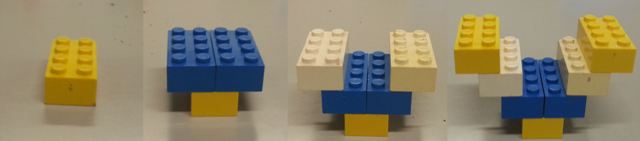
There is a wonderful site called http://visualpatterns.org/ where you can view all sorts of visual patterns that people have submitted. The idea is to work out the next in the series, and then to see how each step is created so that you could predict the 43rd one.

In Year 5G we tried out some of the simpler ones, like this one, submitted by Nic Doran:

How many Lego pieces are in step 43?
We'd already been looking at some sequences, like:


but it was time to create our own:


Here are some of our patterns:


We then set about understanding the pattern mathematically:
  • How does the pattern grow?
  • What number does it grow by each time?
  • What number is there in each step of the pattern?
  • Can you write this with algebra?
  • Can you work out what the 43rd step in the series would be?
We began to answer some of these questions:


The next day we documented our patterns on squared and isometric paper, and tried to understand the mathematics involved. Here's an example on the whiteboard:


Friday, 31 May 2013

Dynamic Symmetry


Years 7, 8 and 9 have been working on some dynamic symmetry problems. These are exemplified by the videos below. The task is quite simply described but less simply achieved..... 'Can you make the following animations using dynamic geometry? ( See the following links for more details... Kaleidoscope, Animated Questions for a discussion on these ideas and 'One Question Lessons' for more thoughts on this type of lesson.)


The activity ticks a lot of boxes, 
  1. The task is easily understood, 
  2. Students really want to have a go because they want to make these really cool animations,
  3. As they work and try things out, they can see straight away if they have achieved what they set out to do. As such, they are getting instant regular feedback on what they have done. they then refine each time trying to get closer to the stated aim. 
  4. In doing the above, students have to reason with each other and articulate mathematical definitions of what they think is going on, of what properties give rise to what behaviours. these are the sort of conversations that make me as a maths teacher delighted and they are very productive for students!
The end results are very pleasing indeed, both in terms of what students produce, but perhaps more importantly in terms of what exploration and discovery they have done together.

For the ambitious, we can then move on to this combination of rotation and reflection!


Older pupils, perhaps in year 9 or above might get interested in this great problem!! Watch carefully to see if you can figure out how this was made! there are lots of surprises in this one. See Dr Who for more details!


Students might go on to making some of the fabulous designs on show with this task - Olympic Logos
Our provision for technology opens lots of doors for us here in Toulouse! Firstly the ease with which we can have a go at these types of tasks and secondly, our choice of media for students to work in. Below are some of the videos that students created whilst doing this task!....


Thursday, 23 May 2013

Triangle Mysteries

Here's a great pattern investigation, that got all of us in Year 5G thinking about patterns in a fresh way - fresh because we'd not come across anything quite like it before.

The activity comes from Steve Humble, and appears in the New York Times. We didn't look at the random aspect of it; we concentrated on what we could see in terms of patterns and rules.

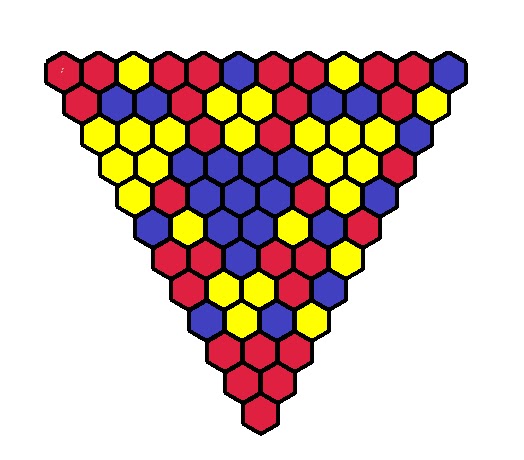
The idea is to to start off with an empty grid like this:
You could download it yourself and have a go...
opening it in Paint. Each hexagon in the top row is filled with blue, red or yellow.

Then for the second row these are the rules:
  1. If the two hexagons above are the same colour as each other, then the hexagon below is that colour. 
  2. If the two hexagons above are different colours, then the hexagon below is the third colour.

Here are some of our patterns:


The patterns are great, but it was the thinking that was the most interesting part!

Here are some of our thoughts, our general statements, about the patterns. Some of them are not in fact true, some of them need investigation...


William: With some of them you turn them and you get the same pattern.

Sophia: There's often a triangle in the pattern.

Jessica: Sometimes you can guess what the colour will be at the bottom.

Chris: If you start with just red and yellow the bottom hexagon will be blue. (Is this always true??)

Christophe: The only one that doesn't have a triangle of colour in it is mine:
Florian: You never know what the colour will be at the bottom.

Jessica: You can tell if it's done correctly because usually there are downward-pointing triangles, never upward-pointing triangles.

Jessica: There is usually a pattern but not always.

Anna: The pattern still works when it is rotated.

Anna: Some of the shapes are symmetrical.


The next day, some of us had time to model a few triangle mysteries in other materials:


and in the playground -