This year we have had our first go at using minecraft in teaching maths! Love it or hate it people, are playing minecraft and whilst the addictive nature of the game is a genuine cause for concern, there seems to be a wonderful element of creativity involved along with some real potential for learning! With some yr 7 and 8 mths classes, we thought we would have a little go at seeing how we could use it. We went for something quite simple and used it as a context for exploring the drawing of 3D shapes, plans and elevations! Students made the shapes on my iPad whilst it was being projected and then we had a go at drawing their plans and elevations. With another class, we took screenshots of the shapes from different angles and used them to try and make isometric drawings of them. It is lovely that minecraft allows you to ‘orbit’ what you have built and look at it from different angles. Students then went on to make their own shapes in mincraft for homework and draw the corresponding plans and elevations. Some even did this in minecraft too! This is a real help with what we were trying to do. There is little doubt that, for now at least, the context was deeply engaging! Thats good enough for now, but we will keep thinking about ways to try and benefit from the minecraft craze! Below are some pictures of what we did.
Monday, 15 April 2013
Minecraft Plans and Elevations!
This year we have had our first go at using minecraft in teaching maths! Love it or hate it people, are playing minecraft and whilst the addictive nature of the game is a genuine cause for concern, there seems to be a wonderful element of creativity involved along with some real potential for learning! With some yr 7 and 8 mths classes, we thought we would have a little go at seeing how we could use it. We went for something quite simple and used it as a context for exploring the drawing of 3D shapes, plans and elevations! Students made the shapes on my iPad whilst it was being projected and then we had a go at drawing their plans and elevations. With another class, we took screenshots of the shapes from different angles and used them to try and make isometric drawings of them. It is lovely that minecraft allows you to ‘orbit’ what you have built and look at it from different angles. Students then went on to make their own shapes in mincraft for homework and draw the corresponding plans and elevations. Some even did this in minecraft too! This is a real help with what we were trying to do. There is little doubt that, for now at least, the context was deeply engaging! Thats good enough for now, but we will keep thinking about ways to try and benefit from the minecraft craze! Below are some pictures of what we did.

Trig Function Families
This is just a quick post about some fun year 11 had with this 'Trig function families' activity. Fun is in somewhat shorter supply as exams approach and so it was great to do something that can really help to understand ideas. The aim of the exercise is to help students understand how the shape of a trigonometric function and its equation are linked. Working with the general form of ....
Students were asked to try and make some of the different images that had been made by varying the values of a, b and c. This is quite different from simply seeing what happens when you vary the values, because you have a particular shape and image to work towards! The results can be very satisfying on the eye! See the slideshow below for some examples.
A slightly different take on the same idea is to try and make the following animations! They are quite are challenge! Are you up for it?
We did find that this was an excellent use for the brilliant online graphing calculator at Desmos. All in all this is an engaging and effective exercise!
f(x) = asinbx + c
Students were asked to try and make some of the different images that had been made by varying the values of a, b and c. This is quite different from simply seeing what happens when you vary the values, because you have a particular shape and image to work towards! The results can be very satisfying on the eye! See the slideshow below for some examples.
A slightly different take on the same idea is to try and make the following animations! They are quite are challenge! Are you up for it?
We did find that this was an excellent use for the brilliant online graphing calculator at Desmos. All in all this is an engaging and effective exercise!
Thursday, 28 March 2013
Maths and Feet

We began by creating squares in the hall with masking tape, naming the directions on the squares and establishing a common language about them.
Next we started the four-beat patterns with simple "copying" of each other's feet positions and moves, where the same shape and movement is simply translated from one square to the next:
We devised our own notations for recording these on paper.

In the second session we revisited our first moves, then we looked at mirror reflection and tried to incorporate this into our four-step patterns.
The idea and inspiration for this activity came from Malke Rosenfield's brilliant "Math in Your Feet" program, though it should be said that ours is a very rough approximation of what is a much more developed and professional program. That said, there were a number of things that were really impressive about what the class did:
- Their total concentration;
- Their amazing and precise cooperation in pairs;
- Their energy;
- Their ability to devise notation to record positions and moves;
- Their use of mathematical vocabulary to describe their patterns.

Wednesday, 27 March 2013
Vibrant Vienna
Taking a turn on the 'Wiener Riesenrad', savouring a segment of sachertort and experiencing Acts I and II of Verdi's Aida...what are they doing on the pinkmathematics blog? Last weekend, six valiant Y9 students and two coaches took part in the annual ISMTF Mathematics Tournament in Vienna, Austria, being hosted this year by the American International School of Vienna.
The competition consists of two different tournaments. The main one where teams of three from each school solve short, long and multiple choice mathematical problems in a series of rounds from 5 to 15 minutes long. The second part of the competition, 'The Sunday Chase,' takes place on the following day. Here the students from individual schools are mixed up to form teams of three from different schools and 'chase' round the school to try and solve as many questions as they can in a set time. The students always have the opportunity to discuss their answers with each other, but aren't allowed outside help or calculators.

Mr Bowles, head coach, took every opportunity to keep mathematical thinking finely tuned, from solving problems in the plane en route to quick warm-ups in the bus on the way to the school each morning.

In between solving many varied mathematical problems that tested their considerable calculating, logical, lateral and reasoning skills to the limit, the group from IST visited the lovely city of Vienna. Under the guidance of the supremely organised and well-informed Mr Bowles and with the help of the seemingly bottomless stock of sweeties provided by one of the students, Antonia, they visited the major sights and experienced at first hand the world-famous Vienna State opera, the famous 64m high ferris wheel at Prater park, a five-star 'heiße Schokolade und sachertorte' at the 'Café Sacher' and a tour of the most famous sights. In addition, they met many other students from all over Europe and the Middle East, coming together with a single aim - to do maths, but also relaxing with each other as they viewed a fascinating part of Europe.

Another highlight of the weekend was the immensely impressive 'Technisches Museum', a trip sponsored by the AIS. Here amongst the incredibly varied exhibits, they found many familiar and not so familiar machines and gadgets people use from day to day and throughout history. Mr Bowles once again tested their powers of observation and logic by playing 'guess the function of the machine' and most forged a new skill - one of presenting the Austrian news complete with auto-cue in German in a lifelike mock up of a studio.

This year's winning team, from Luxembourg shall be hosting next year's tournament. For the Y9 students, they have their sights set on the Junior Challenge in a couple of year's time when they are in Y11. Whether they take part or not, it is certain that their weekend in Vienna has given them masses of mathematical involvement and opportunities.


Well done to everyone involved!
The competition consists of two different tournaments. The main one where teams of three from each school solve short, long and multiple choice mathematical problems in a series of rounds from 5 to 15 minutes long. The second part of the competition, 'The Sunday Chase,' takes place on the following day. Here the students from individual schools are mixed up to form teams of three from different schools and 'chase' round the school to try and solve as many questions as they can in a set time. The students always have the opportunity to discuss their answers with each other, but aren't allowed outside help or calculators.

Mr Bowles, head coach, took every opportunity to keep mathematical thinking finely tuned, from solving problems in the plane en route to quick warm-ups in the bus on the way to the school each morning.

In between solving many varied mathematical problems that tested their considerable calculating, logical, lateral and reasoning skills to the limit, the group from IST visited the lovely city of Vienna. Under the guidance of the supremely organised and well-informed Mr Bowles and with the help of the seemingly bottomless stock of sweeties provided by one of the students, Antonia, they visited the major sights and experienced at first hand the world-famous Vienna State opera, the famous 64m high ferris wheel at Prater park, a five-star 'heiße Schokolade und sachertorte' at the 'Café Sacher' and a tour of the most famous sights. In addition, they met many other students from all over Europe and the Middle East, coming together with a single aim - to do maths, but also relaxing with each other as they viewed a fascinating part of Europe.
 |
| Team IST with students from Sir James Henderson School, Milan outside the Schônbrunn Palace |

Another highlight of the weekend was the immensely impressive 'Technisches Museum', a trip sponsored by the AIS. Here amongst the incredibly varied exhibits, they found many familiar and not so familiar machines and gadgets people use from day to day and throughout history. Mr Bowles once again tested their powers of observation and logic by playing 'guess the function of the machine' and most forged a new skill - one of presenting the Austrian news complete with auto-cue in German in a lifelike mock up of a studio.

This year's winning team, from Luxembourg shall be hosting next year's tournament. For the Y9 students, they have their sights set on the Junior Challenge in a couple of year's time when they are in Y11. Whether they take part or not, it is certain that their weekend in Vienna has given them masses of mathematical involvement and opportunities.


Well done to everyone involved!
Thursday, 14 February 2013
Tak-tiles
 |
| by Jessica |
We borrowed these ones from secondary,
 |
| Tak-tiles |

First we named the basic areas (not shapes). No sooner had we named c than Sophie observed that a is made up of b and c.
Harry put it as equation:
b + c = a

The blue rectangle on the right for instance is two of the a-squares, to be written 2a.
Someone noticed that sometimes you could describe an area in more than one way, for instance with the red shape on the left of the puzzle:

So we got creating, filling the empty grid to make our designs:

Here's some of our work:

Millie's M for instance, we worked out to be 6a + 4b.


There's lots more. What would be the area of Max's green dragon be?
And then more tricky questions. Someone objected that those white "eye shapes" in Max's design aren't allowed. But when we thought carefully about it we realised we could describe it with the abcs.

You could easily have a go at creating a design yourself. Just click on the blank grid and download it. Then open it in Paint or whatever colouring-in program you prefer - and go.)
 |
| by Amandine |
Monday, 4 February 2013
Important factors
People normally draw factor trees like this:
 This isn't right in three ways:

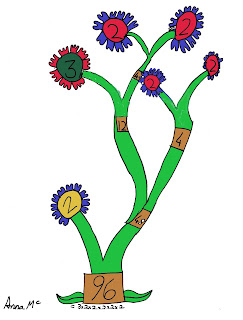
Then we drew some different factor trees to investigate the question "What different factor trees can you make for 96?" -




You can see a bigger version here.
At the same time we played a game, Ocean of Primes, adapted from the nrich Factor Track:




- First of all, it should be a tree that goes up and actually looks like a tree.
- As the prime factors are so important, they should stand out.
- And - the trees should be a bit more beautiful than this.

Then we drew some different factor trees to investigate the question "What different factor trees can you make for 96?" -


Next, we thought about what mathematical questions about prime numbers we could investigate. Here are some of them:
Ella-May - Do all numbers have a two and a three as one of their prime factors?
Mr Gregg - Are there any other numbers less than 100 with six prime factors?
Sophie - Would an odd number have as many prime factors as an even number?
William - Do bigger numbers have more prime factors?
Harry - Do bigger numbers have bigger prime factors?
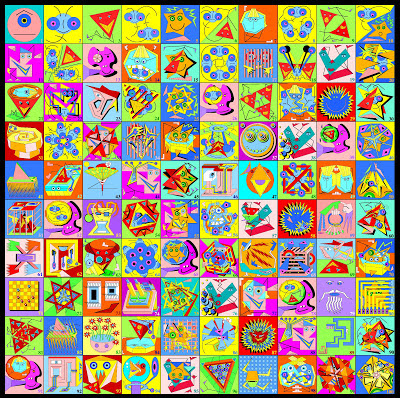
Some children suggested we make a huge forest of trees for lots of numbers. Here's part of it:

At the same time we played a game, Ocean of Primes, adapted from the nrich Factor Track:


To round off this term's work on factorisation we looked at a great book, Richard Evan Schwartz's You Can Count on Monsters.

In this book, all the prime numbers are monsters with particular shapes:
 |
| Two |
 |
| Three |
 |
| Five |
 |
| Seven |
Other numbers have designs made up of these ones. For instance, here's 14:
 |
| 14 has 7 and 2 as prime factors, so they're in the picture |
We had a good look at the book and the poster:

After we'd absorbed what was going on, we created some of our own in a similar style:

Each has the prime factors of the number illustrated:
 |
| Anna: 24 has the prime factors 3, 2, 2 and 2 |
 |
| Emily: 104 has 13, 2, 2 and 2 as prime factors |
 |
| Sophie: The prime factors of 144 are 3, 2, 2, 3, 2, 2 |
UPDATE - FEBRUARY 2016 - THOUGHT FLOWERS

Subscribe to:
Posts (Atom)